
Neighbors for More Neighbors A2 Wants Answers From Council Candidates, But Members of the Group Have Some Explaining to Do
by P.D. Lesko
Perhaps you’ve seen the yard signs: Neighbors for More Neighbors. The signs are made available by a “Team of Neighbors” who want to densify Ann Arbor through influencing public policy, including planning and zoning. That same Team of Neighbors recently sent out a survey to City Council candidates with eleven questions about candidates’ views on upzoning neighborhoods to allow multi-family residences and apartment buildings. Ward 1 Council candidate Rebecca Arends sent a polite yet pointed answer to the Neighbors for More Neighbors invitation. Arends raised questions about the credibility of the group and the motives of its “Team of Neighbors.”
In response to the Neighbors for More Neighbors request to answer questions, several of them leading (Did you support Props A & B in 2025 to expand AADL’s Downtown Branch into the neighboring lot and build housing above it? (Y/N) Please explain your stance.), Arends sent an email in which she explained exactly why she would not be engaging with the Team of Neighbors:
“I appreciate your outreach and the multiple requests. As I stated previously, I do not feel comfortable engaging with an organization whose public-facing culture, through the conduct of several of its members over time, has too often reflected unnecessary negativity on social media — including sarcasm, mocking, gaslighting, elitist commentary, minimizing, and a dismissive framing toward those who raise questions or dissenting perspectives.
“In civic life, disagreement is inevitable and often healthy. But organizations, especially those that seek to influence public dialogue and policy, also carry a responsibility to model intellectual honesty, restraint, and basic civility in how they engage with others — particularly neighbors, residents, and community voices who may not fully align with them. The tone an organization tolerates publicly ultimately shapes the trust it can build privately. We have all had times we failed in this ideal, and I understand that. However, as a future CM, I am committed to refraining from that behavior on social media.”
Linda Dabrowski says she attended a meeting of City Council focused on zoning and land use. “This organization lost me completely when one of their members used a Mr. Nimby prop at a city council meeting. I wouldn’t consider this group a reliable or transparent source of information.”
Another Ann Arbor resident who attended the same City Council meeting said, “Yes, Mr. Lowe [Alex Lowe, listed among the Team of Neighbors] spoke just before me using his little [Mr. Nimby] puppet and a squeaky voice.”
Alex Lowe, while touting the importance of multi-family housing, upzoning and density for other people, purchased a single-family home in Pittsfield Village in 2024, according to public records.
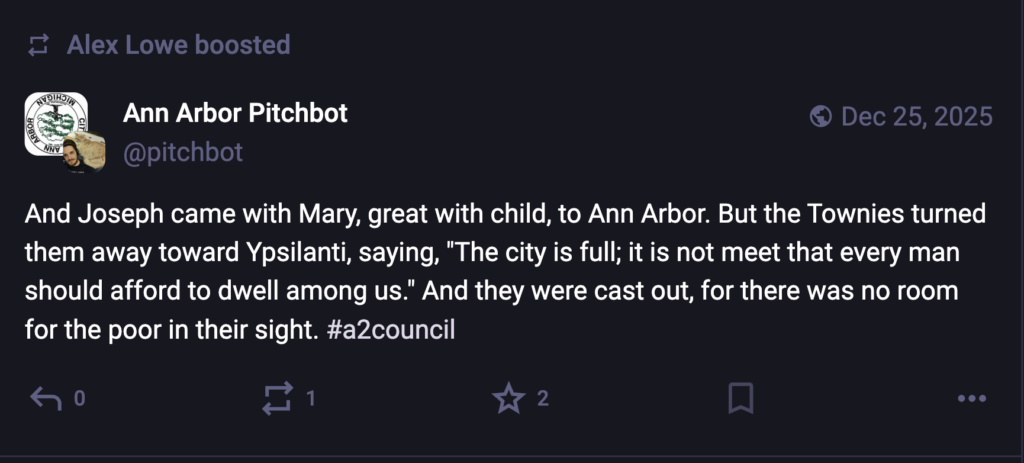
Saraellen Strongman is an assistant professor of Afroamerican and African studies at the University of Michigan. Like Lowe, Strongman has been a vocal proponent of the need for Ann Arbor residents to embrace multi-family housing situated near transit and shops. Strongman has concerned herself with the racism that has been associated with neighborhoods zoned exclusively for single-family housing.
Like Alex Lowe, when she purchased her home in 2020, Strongman spent $401,000 on a 4-bedroom single-family home in the middle of a tidy neighborhood near Stadium Blvd. According to Assessor’s records, Strongman’s house has appreciated $140,000 since she purchased it for herself, a more than 30 percent return on her investment. Single-family zoning did not price Strongman out of the wealthy, middle-class, and well-resourced neighborhood she chose.
Of the 20 Neighborhood Team Members identified on the Neighbors of More Neighbors Ann Arbor website, Assessor’s records show that virtually all of them are single-family home owners who purchased their homes in neighborhoods zoned for exclusionary single-family homes. Several of the Team Members own homes in Burns Park, where “gentle density” is now permitted (duplexes, triplexes and ADUs) but not low- to mid-rise apartments and mixed-use developments.
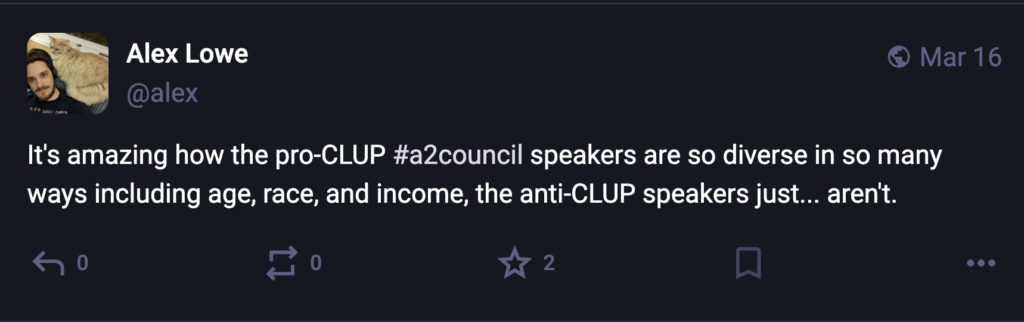
Strongman is identified in a recent email sent to City Council candidates requesting that the candidates answer questions put to them by Neighbors of More Neighbors Ann Arbor as a member of the Neighbors for More Neighbors Ann Arbor “Election Committee.” Like Neighbors for More Neighbors Team member Alex Lowe, Strongman has used social media to mock those whose opinions on the need for neighborhood density don’t agree with hers.
Neighbors for More Neighbors Ann Arbor: Not a Registered Non-Profit, PAC or Business Entity
The email to the Council candidates urging them to answer an 11 question survey composed by the members of the Neighbors for More Neighbors Ann Arbor Team members lists a 10-member “Board of Directors” (including Strongman) and a four-member “Election Committee.” On the Neighbors for More Neighbors Ann Arbor website, no Board of Directors or Election Committee is listed. In the email to Council candidates signed by the “Board of Directors” and the “Election Committee,” it says, “Housing policy is a central concern of our organization and our members.” The mail also states, “MNA2 is an organization that advocates for safe, attainable housing for all in Ann Arbor and our surrounding community.”
However, Neighbors for More Neighbors Ann Arbor is not an organization that is registered with either the IRS Charitable Division or the State of Michigan’s Business Registration.
The website has no option for people to join and lists no member benefits. It’s unclear how Neighbors for More Neighbors Ann Arbor has “members” to whom anything is a central concern other than to the 20 people listed on the website’s About page. In an email, the Board was asked how many members Neighbors for More Neighbors Ann Arbor has and how many people receive the newsletter. The email has not yet been answered. No newsletters are available on the Neighbors for More Neighbors Ann Arbor website.
Webpage visitors are encouraged to “Get Involved.” That includes giving money to the people who control Neighbors for More Neighbors Ann Arbor. Donations may be made in the form of checks which may be brought to a monthly general meeting. No meeting minutes are posted to the Neighbors for More Neighbors Ann Arbor website. There are no financial records made public, but there are volunteer opportunities including delivering yard signs, organizing events and providing childcare.
Without a legal EIN or TIN issued by the government, it’s not clear how Neighbors for More Neighbors Ann Arbor can legally accept checks, or cash them.
As the people listed on the About page solicit donations, in an email the Board was asked how much money has been brought in and how items like the signs Neighbors for More Neighbors Ann Arbor gives out are paid for. The question has not been answered.
Ward 1 City Council candidate Rebecca Arends says, “There is a recurring pattern of portraying opponents of the Comprehensive Plan as privileged, exclusionary, complainers, conspiracy theorists, or people whose concerns do not deserve serious consideration.”
Screenshots of the social media posts made by members of the Neighbors for More Neighbors Ann Arbor “Team” show a deep disdain for, and a pervasive bias against, the differing opinions of their neighbors.
On a local Facebook politics page, Kaurav Kulkarni identified himself as a Neighbors for More Neighbors Ann Arbor Board member. He assured the page’s 5,200 readers that, “We want candidates to be able to represent themselves, using their own voice. And we will promote their answers to our members and the broader community.”
Mayoral candidate Yousef Rabhi and several other City Council candidates, including Arends, elected not to respond to the Neighbors for More Neighbors Ann Arbor political survey.
Comments are closed, but trackbacks and pingbacks are open.