
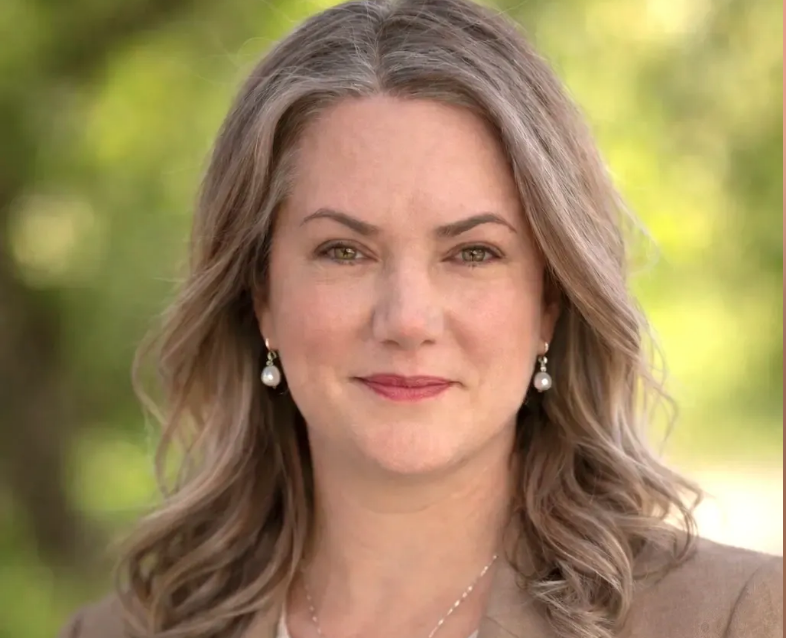
Ward One Council Candidate Uncovers Waste, Duplication of Efforts and Foot-dragging in Implementing Unarmed Police Response
Editor’s Note: Ward One City Council candidate Rebecca Arends used the Freedom of Information Act to obtain public records to try to understand why, several years after City Council allocated more than $3.5 million to shape and implement an unarmed police response plan, no plan has been crafted or implemented. In an email, Arends asked City Administrator Milton Dohoney to explain precisely on what $105,000 of funding for the plan had been spent (consultants). Then, Arends used the Freedom of Information Act to obtain over 1,000 pages of public records documenting Council’s directive to City staff to implement an unarmed police response program and City staff’s failure to do so.
Ann Arbor Social Worker Rebecca Arends is not accepting donations, sending out glossy mailers or giving supporters campaign yard signs to advertise her candidacy. She is visiting her Ward One neighbors by knocking on their doors and chatting them up on their front porches. Arends plans to knock thousands of doors before the Aug. 4, 2026 primary election. Arends wrote the piece, below, and it appears on her campaign website.
Four Years, $3.5 Million, and Still No Viable Program
May 27, 2026
Over the past several months, I submitted several FOIA requests seeking clarity regarding Ann Arbor’s proposed unarmed response initiative. As a social worker who encounters crisis situations and observes in real time the excellent work that Washtenaw County Community Mental Health clinicians do, I wanted clarity on what seemed to be a duplication of services.
What the records reveal is concerning.
After four (now five, counting from April 2021) years of planning, consultant spending, public engagement campaigns, procurement attempts, and political promotion, the city itself repeatedly acknowledged that this proposal has been operationally fragile, expensive, and difficult from the beginning.
According to city records:
- Ann Arbor originally allocated $3.5 million in ARPA funding toward an unarmed response initiative
- approximately $105,000 was spent on public engagement and consulting
- Public Sector Consultants were hired; the report repeatedly reveals distrust of police as a foundational driver
- two Requests for Proposals failed
- more than $3.39 million had to be reallocated because the city could not operationalize the program within federal deadlines
Contradictions Within the City’s Own Report
What is striking about the March 2023 City’s own Public Sector Consultants report is the number of operational contradictions it contains.
The report frames the initiative as an alternative crisis-response model that can reduce police involvement in behavioral-health calls. But throughout the same report, participants repeatedly acknowledge:
- concerns about responder safety
- the dangers of domestic violence calls
- the need for police backup during escalation
- potential for staffing burnout
- liability concerns
- dispatch complexity
The report also raises concerns about service duplication and confusion for callers, while emphasizing the need to coordinate closely with existing providers, including Washtenaw County Community Mental Health, PATH, homelessness services, and co-response systems already operating in the county.
Even more striking, the report repeatedly acknowledges that all proposed services already existed in some form through current CMH crisis infrastructure, outreach programs, and collaborative response systems.
In other words, even the City’s own consulting report appears to reveal an unresolved tension between the political vision being promoted publicly and the operational realities of building a sustainable emergency-response system.
The Procurement Failures Matter More Than Most People Realize
Two failed RFPs is not a small issue.
That often means one of several things:
- vendors did not think the model was viable
- funding was insufficient
- liability was too high
- staffing expectations were unrealistic
- scope was unclear
- or operational expectations were contradictory
Organizations do not usually walk away from funded government contracts unless something structurally concerns them.
That part deserves more public scrutiny.
Fiscally and Pragmatically Irresponsible
The records further show that City Administrator Milton Dohoney repeatedly emphasized the operational complexity and limitations involved, as well as appropriate pushback from Washtenaw County CMH.
On January 8, 2026, shortly after I emailed his office to inquire about the progress on this issue, he sent a memorandum to the Council. He wrote: “CMH seemingly does not share that view. Their feelings are so strong about it that they may rethink responding within city limits if we place a co-response unit in the field.”
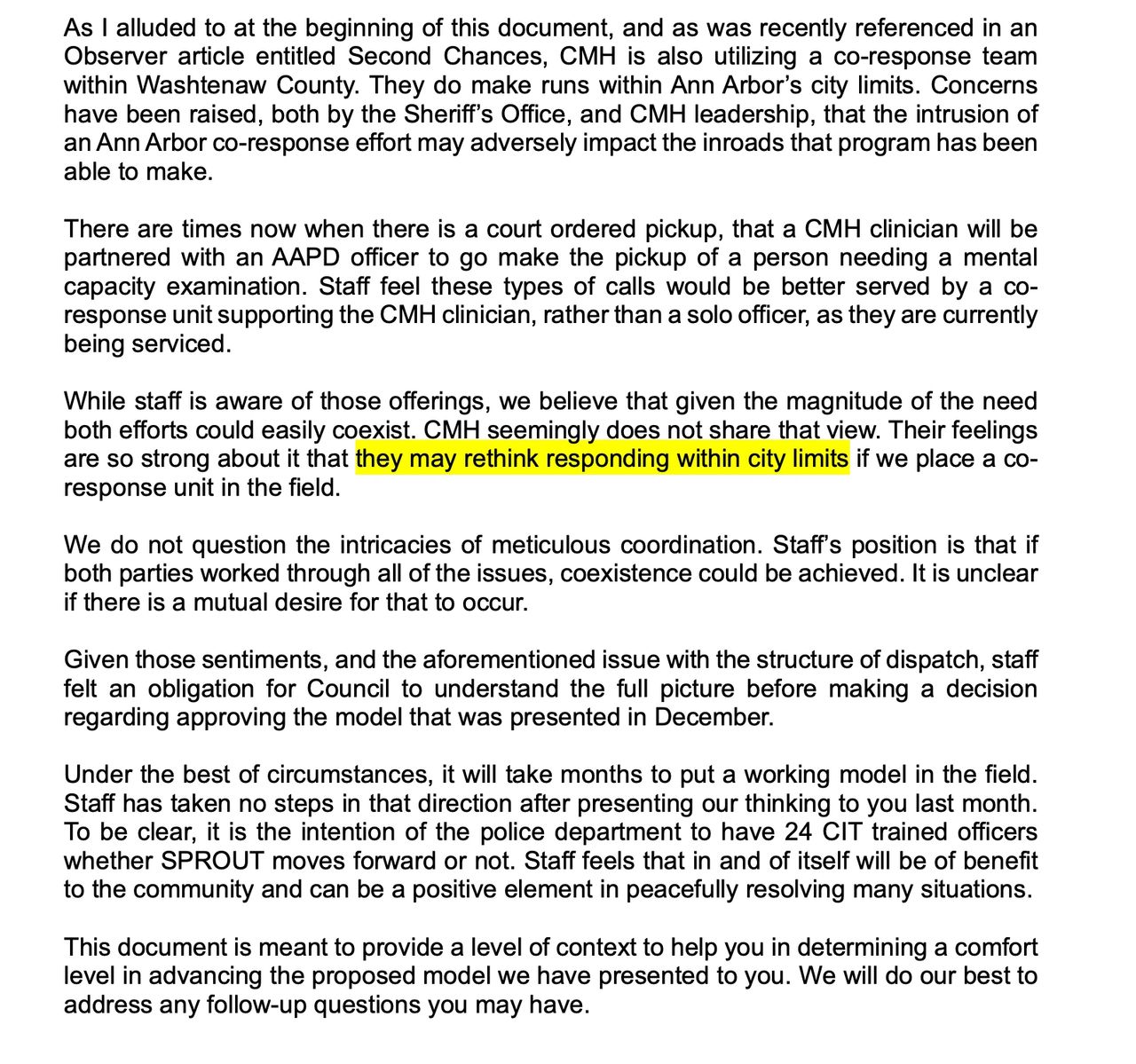
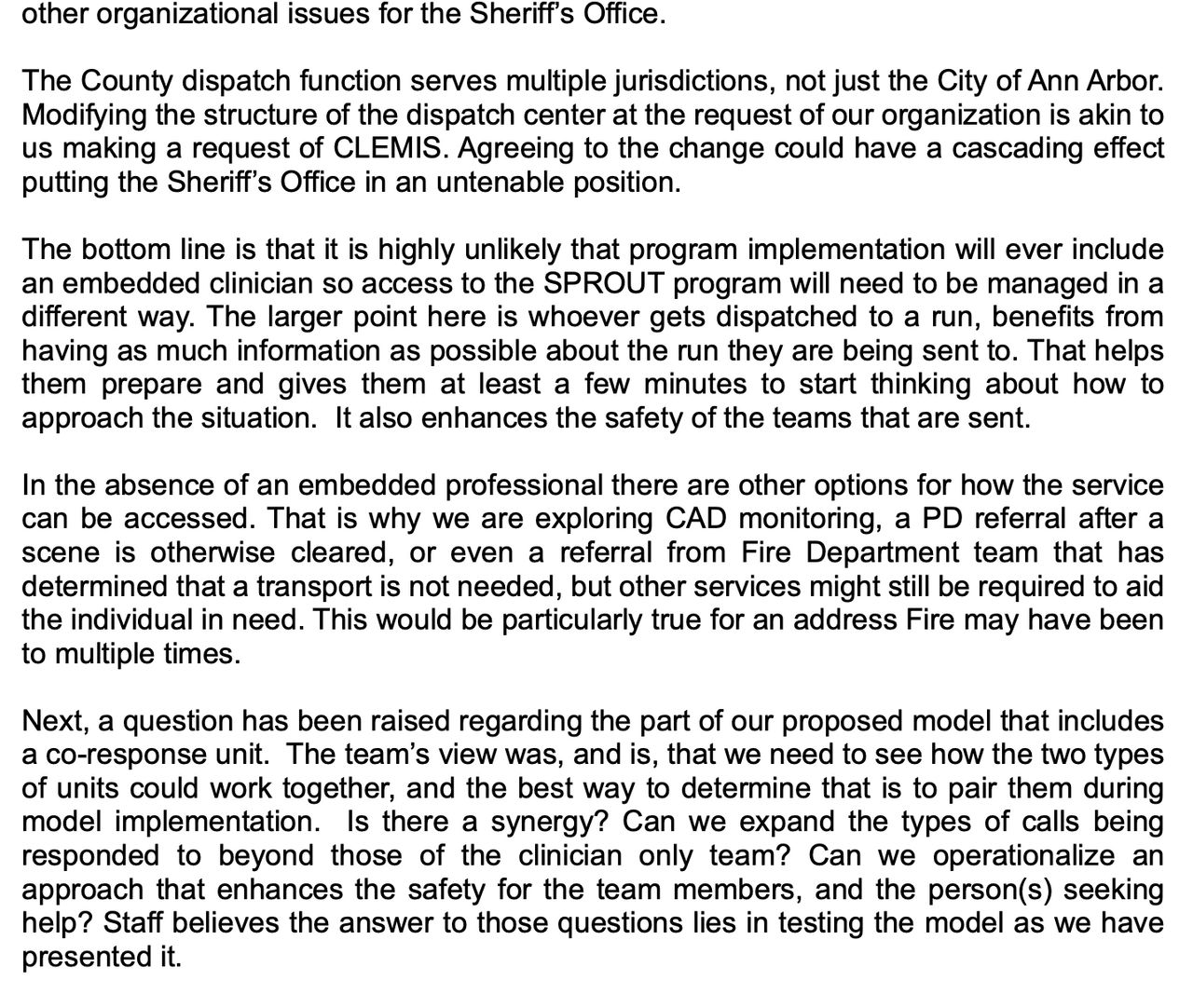
This is an administration confronting how difficult, expensive, and uncertain this effort actually is.
And Ann Arbor is not alone in encountering these obstacles.
Cities across the country that pursued unarmed response programs have consistently discovered that these systems are extraordinarily expensive, operationally narrow, difficult to staff, and heavily dependent on careful dispatch criteria, infrastructure, and long-term funding streams.
Many are not 24/7. Most still rely on law enforcement backup or co-response models. Even supporters of these programs frequently acknowledge the complexity involved in scaling them safely and sustainably.
One thing that becomes increasingly clear throughout the FOIA records is that the public rhetoric surrounding this proposal often sounded much broader than the operational model being discussed internally.
Publicly, residents often heard language suggesting an alternative emergency response system capable of crisis intervention, field deployment, and behavioral emergency diversion.
All of these functions are already being performed by Washtenaw County Community Mental Health through existing mobile crisis teams, outreach services, stabilization efforts, co-response systems, and follow-up care coordination, which residents fund through the county mental health millage.
Residents deserve clarity about what this program is actually intended to do, whether it fills a genuinely unmet operational need, and whether public expectations aligned with operational reality.
As a social worker, I believe deeply in compassionate crisis intervention. I also see clinicians throughout Washtenaw County doing meaningful and difficult work every day in collaboration with law enforcement, EMS, hospitals, CMH, and co-response systems. Again, those partnerships already exist. They are already helping residents in crisis.
Is Ann Arbor building creating another expensive layer that risks duplicating existing systems, fragmenting care coordination, and destabilizing services that are already functioning?
The FOIA records themselves show internal concern about this potential fact.
One communication states:
“I am not comfortable moving forward with a model that risks fragmentation of services duplication of effort or the potential withdrawal of an established provider from within city limits.”
That should alarm every resident.
Because the goal appears be to expand effective services — not to unintentionally undermine or compete with systems that are already operating across the county that we already pay for with our mental health millage.
The records also acknowledge the extensive work already being done by Washtenaw County Community Mental Health:
- more than 4,800 crisis service requests involving Ann Arbor residents
- over 2,000 unduplicated crisis responses
- 73% of outreach encounters resolved without hospitalization
- and ongoing stabilization follow-up that far exceeds many peer counties
As someone trained in behavioral health I can also say clearly that many crisis calls involve:
- psychosis
- intoxication
- suicidal behavior
- domestic violence
- paranoia
- escalating agitation
Many clinicians do not want to enter unstable domestic violence or psychosis scenes without immediate backup available. That is not stigma. That is responsible risk assessment. This is why the psychiatric ER is staffed with security. Speaking with CMH staff, they are frustrated and baffled at this proposal.
Why has the city now approved an additional quarter of a million dollars for a proposal that has already consumed years of planning consultant spending, engagement campaigns, and failed procurement efforts, without producing an operational program? Clearly from the documents CMH and the sheriff’s office are not on board with this effort.
What specific new information exists today that did not exist after more than four years of work?
What measurable deliverable will taxpayers receive?
Will this fund actual operational staffing and field response capability, or another cycle of studies, meetings, consultants, and political process? Will this create unintended consequences with Washtenaw County CMH and complicate the already difficult work of crisis response in Ann Arbor?
At the doors, residents repeatedly tell me they are exhausted by rising costs, rising property taxes, consultant culture, and a growing sense that city government spends enormous amounts of money studying problems rather than solving them.
People are worried about affordability.
They are worried about staying in their homes.
They are worried about young families being priced out of Ann Arbor.
Residents are frustrated watching millions of dollars move through studies, consultants, branding initiatives, pilot concepts, and administrative processes, while basic concerns about infrastructure, housing affordability, and quality of life continue to grow.
We deserve mental health services that are:
- clinically sound
- operationally realistic
- financially sustainable
- measurable
- transparent
- and accountable
Compassion matters. But competence matters too.
Good governance requires the ability to reassess failed approaches honestly.
Ann Arbor cannot afford governance driven primarily by symbolism, endless process, and initiatives that repeatedly fail to produce operational results.
Comments are closed, but trackbacks and pingbacks are open.