
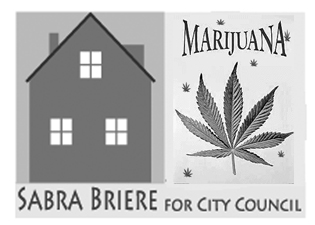
Critics Allege Secondhand Drug Money Helped Finance Sabra Briere’s Reelection To City Council In November 2013
IN HER 2013 City Council race, almost half of Ward 1 Council member Sabra Briere’s 2013 campaign funds came from money donated by the owners of medical marijuana dispensaries. The owner of a local dispensary held a fundraiser for Briere that was attended by dispensary owners from across metro-Detroit. She accepted campaign donations in amounts ranging from $50 to $500 from dispensary owners in Redford, Ferndale, Macomb, Canton and New Buffalo, Michigan.
The sale of marijuana is illegal according to federal law. Michigan’s Marijuana Law, clarified by the Michigan Supreme Court in a February 2013 decision, prohibits dispensaries and restricts sales of the drug, as well. Local marijuana entrepreneurs hope a City Council member will introduce an ordinance to protect their businesses in the city.

Briere’s November 2013 opponent, Jeffrey Hayner, commented in response to an article about Briere’s entry into the mayoral contest: “Anyone can view the potential role special interest money has in local politics via the candidate’s campaign finance forms, by going to the Washtenaw County Elections website….Taking into account he post-election reposting and balances, it looks more like she spent around $8000 in this campaign, or about $7/vote. So the money raised from the medical marijuana dispensaries accounted for about 1/2 of her total campaign spending.”
Ward 4 Council member Jack Eaton, a labor lawyer, turned down a proffered donation from a local dispensary owner during the August 2013 Democratic primary election. “That’s drug money and drugs are illegal,” said Eaton.
Most banks remain leery of accepting deposits from marijuana dispensaries for fear that such banks could lose their charters, attract unwanted attention from regulators or even risk prosecution.
Attorney General Eric H. Holder Jr. recently told the media that lawful marijuana businesses should have access to the American banking system and that the government would soon offer rules to help them gain it. The rules are not expected to give banks a green light to accept deposits and provide other services, but would tell prosecutors not to prioritize cases involving legal marijuana businesses that use banks.
It remains unclear what exactly any new proposed federal guidelines would say, and whether they would apply to states that allow medical marijuana, or just to Colorado and Washington, where the drug is legal in small amounts for anyone 21 or older.
Briere’s mayoral campaign organization forms dated January 10, 2014 indicate her money is held by PNC Bank. PNC is a publicly-traded corporation whose stock is listed on the New York Stock Exchange. Bank officials indicated that the company does not accept money from marijuana dispensary owners nor would PNC accept deposits from any customer whose money could be directly or indirectly linked to the sale of illegal drugs.
Jimmy Gurule is a former enforcement official at the U.S. Treasury who is now a University of Notre Dame law-school professor. When asked whether banks would do business with dispensaries, he told Reuters in September 2013: “There are simply too many unanswered questions at this time. I don’t think that the banks will run the risk of criminal prosecution.”
 In June 2011, City Council passed a resolution that outlined where medical marijuana businesses could be located. In September 2011, Council members voted a 10-0 vote to appoint four individuals, including one Council member, to the city’s new Ann Arbor Medical Marijuana Advisory Board.
One month later, Briere accepted a $500 campaign donation from Mark Passerini, a University of Michigan graduate and co-founder of the OM of Medicine (medical marijuana) dispensary on Main Street. Passerini’s was one of the largest legal donations she received in 2011.
To put the donation in perspective, at an October 2011 fundraiser attended by 20 people Briere took in $50 total. That fundraiser cost $264 to put on.
In January 2012, Briere was appointed to the Medical Marijuana Licensing Board she voted to create in September 2012. Briere then voted to give out 10 licenses to marijuana entrepreneurs who wanted to operate in the city, including one to Passerini for his business Om of Medicine.
In October 2013, at a fundraiser held at Om of Medicine, half a dozen of the marijuana entrepreneurs to whom Briere had voted to give licenses made maximum amount donations ($500) to her campaign for City Council. Half of Briere’s campaign spending in her 2013 re-election bid came from money donated by medical marijuana dispensary owners.
Local elected officials in cities across the country are passing rules that forbid campaign donations from marijuana dispensary owners.
In order to eliminate what San Jose, California Council members referred to as “a corrupting influence on public policy makers at a time when the City is working to develop regulations for these establishments,” in January 2014, Council members in that California city approved a resolution that prohibits medical marijuana dispensary owners, spouses and key dispensary employees from donating money to candidates for local office.
The resolution reads, in part, “The City Council should prohibit campaign contributions from medical marijuana establishments and their representatives, to avoid the appearance of conflicts of interest and to minimize the influence of an industry dedicated to the sale of a substance that remains illegal under federal law.”
Ward 1 Council member Sabra Briere did not respond to requests for comment.