
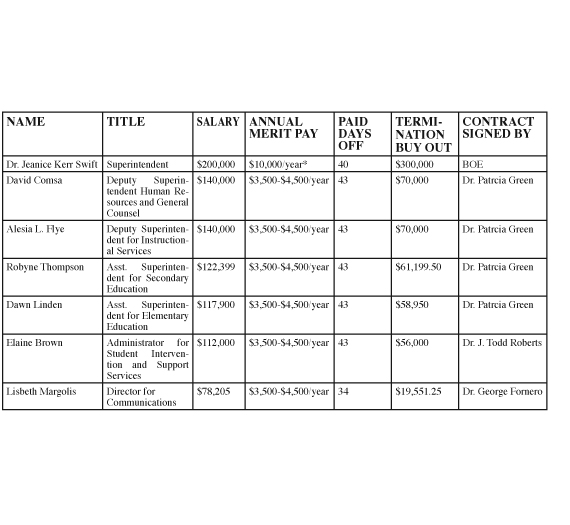
THE ANN ARBOR Independent used a Freedom of Information Act (FOIA) request to get copies of the employment contracts between the AAPS Board of Education and the school district’s top-level administrators, including Superintendent Dr. Jeanice Kerr Swift. The employment contracts reveal that the Board of Education pays top-level administrators between $78,205 and $200,000 per year, plus perks and benefits. Top-level administrators—with one exception—enjoy 43 paid days off each year and termination payments equal to six months pay should the administrator be fired with cause, including for moral turpitude.
The various administrators are given between 20-25 days of paid vacation each year, 12 sick days, three personal days and some are given three paid days off to be used to provide “consulting services to other education institutions or other organizations as they may be requested.” Such requests, however, must be approved by the Superintendent.
With the exception of Dr. Swift, all of the top-level administrators in the district have contracts which include the payment of performance bonuses of between $3,500 and $4,500 per year.
All the rage a few years ago, the number of school districts that pay performance bonuses has diminished considerably, according to Paul Houston executive director of the American Association of School Administrators (AASA).
“Measuring performance has always been the most difficult part,” he says. He adds that many districts have found themselves in the midst of a political hornet’s nest when a district administrator scores a bonus for student achievement while the teachers or principals who work with the kids day in and day out receive nothing.”
Conversely, with the exception of Dr. Swift, no other top-level administrator receives so-called golden-handcuff payments.
Golden-handcuff clauses—contractual clauses that offer a cash incentive to administrators simply for staying put—have become common in contracts between school boards and superintendents. That’s because there’s a shortage of good superintendents, and boards are concerned that good ones will be recruited out of their districts if not given a compelling reason to hang around.
“Golden handcuffs are designed to keep districts from stealing,” Houston says.
While the local media have focused almost exclusively on the salary awarded to Dr. Swift, there has been little discussion of the cost of perks paid to Dr. Swift.
A 2006 report by the New Jersey Commission of Investigation called for greater transparency in reporting school superintendents’ perks and bonuses. The commission says school boards should do a better job of reporting real salaries to the public.
The report contends that public disclosure of superintendents’ true salaries is poor, and that the public needs to be better informed about how superintendents are compensated, with special consideration made to pension calculations.
One of the recommendations includes a blanket prohibition against the annual cashing-in of unused accumulated leave. Dr. Swift’s contract calls for her to be paid for unused vacation days if she is terminated, and allows her to cash out up to 10 unused vacation days each year, a benefit worth $5,400. The district’s top-level administrators have the option of cashing out unused vacation days only if they lose their jobs.
While Dr. Swift’s base salary has drawn intense criticism from locals, and is on par with base salaries paid to superintendents who oversee school districts with enrollments 10 times larger than hers, it is by no means the most egregious example of over-generosity on the part of a board of education.
Jose Fernandez is the superintendent of the 6,600-pupil Centinela Valley Unified High School District in California. He received more than $663,000 in total compensation in 2013.
In addition to his salary, Fernandez was allowed to buy retirement years. He also has a 215 workday contract and is paid an additional $50,000 for days worked beyond the contract. His contract includes an annual raise of nine percent and stipulates he can only be fired by a supermajority of the board. He negotiated an option to take a low-interest loan from the school district to purchase a home. As a result, Fernandez was given a $910,000 loan at two percent interest for 40 years.
The Mackinac Center for Public Policy has an online database of Michigan public school superintendent compensation. The Kalamazoo Public School District tops that list with a $349,178 compensation package for the superintendent of its 12,471 student district. Ann Arbor is number eight on the 606 district list with a superintendent compensation package of $273,551. This calculation includes base salary, pension annuity and insurance payments but not perks.

