
City Planning Commissioners’ Removal of Hundreds of Acres of Public Parkland From New City Land Use Plan Is Improper, Says Neighborhood Group
The unexplained deletion paves the way for development, subverts the will of the voters, and exposes the city to potential legal and financial fallout, says Ann Arbor Neighborhood Network group in its “Ann Arbor’s Parkland and Public Trust” report.
by John Godfrey
“The second draft of the City of Ann Arbor’s Comprehensive Land Use Plan (CLUP) released June 10, excludes more than 484 acres of publicly owned parkland, including both of its two municipal golf courses and multiple nature areas. The omissions could pave the way for development on land previously protected by the City Charter—and have major financial and legal consequences,” states a press release sent out by the Ann Arbor Neighborhood Group.
According to the second draft of the CLUP, the Plan “is not a law, and its adoption does not change any laws, regulations, or requirements that apply to the physical development of the city. Rather, it provides strategic direction on how regulations should evolve to achieve our goals.”
The Ann Arbor Neighborhood Group’s report states the second draft of the CLUP was analyzed, and A2NG members allege the drafters of the CLUP (city staff and members of the Ann Arbor Planning Commission) relied on “incomplete parkland data sourced from the Trust for Public Land’s (TPL) ParkServe system.”
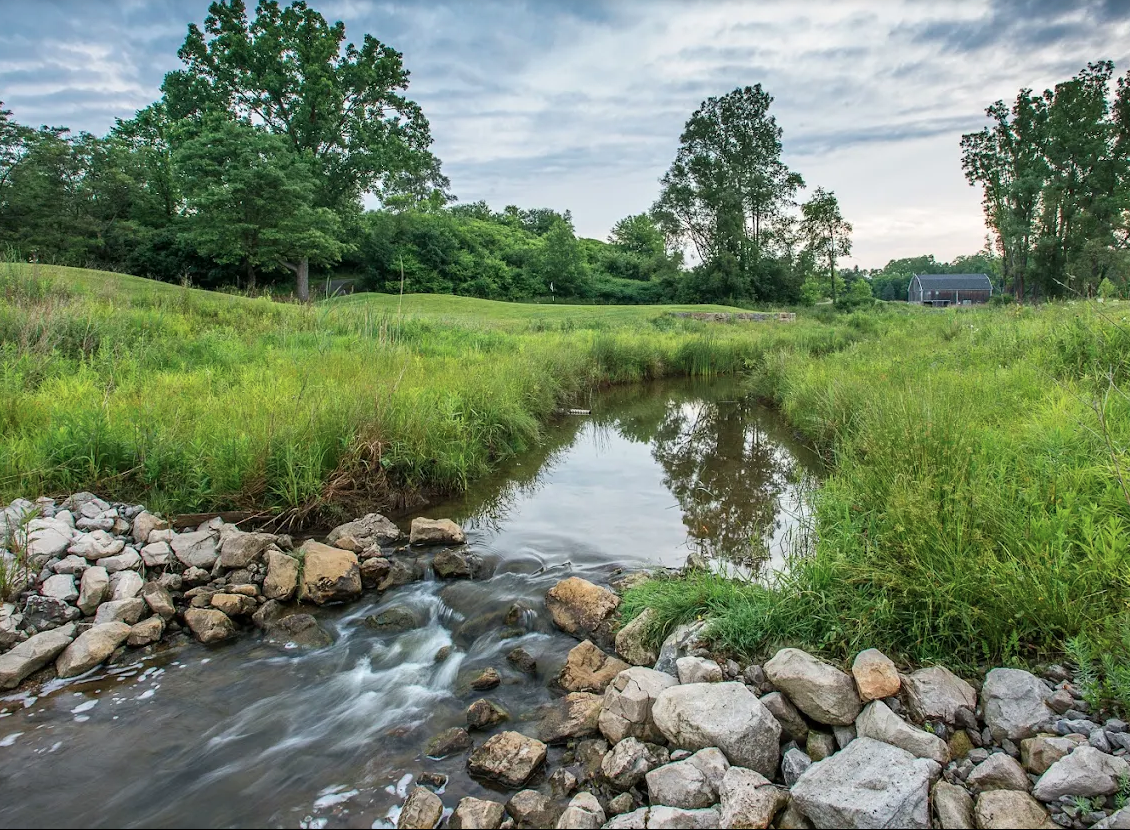
The second draft of the CLUP omits 484 acres of present park assets including Huron Hills and Leslie Park golf courses, Buttonbush, Hickory, and Willow Nature Areas, and other green spaces.
City Council members, in response to pushback from residents concerned about the CLUP strategy to upzone all land zoned residential, have said that the members of the Planning Commission control the contents of the CLUP and the process whereby citizen input is solicited. Thus far, the members of the Planning Commission have solicited the input of Ann Arbor residents only through electronic means.
According to Ann Arbor City Planner Michelle Bennett, currently 94 percent of Ann Arbor’s land is zoned residential. The proposed CLUP would make 100 percent of land in Ann Arbor zoned residential and include upzoning in all areas zoned residential. While the change might appear small, the addition of multi-story, multi-family zoning, and a developer’s ability to combine multiple residential lots to construct larger multi-story, multi-family buildings in single-family zoned areas would, according to Bennett in a comment before City Council, “enable 30,000 to 97,000 new units.” Bennet added, “97,000 would be more than what New York City is trying to enable.”
The CLUP seeks to tackle an issue that has plagued the City for decades: “Many of Ann Arbor’s vehicle miles traveled are by people going to work. Over half of Ann Arbor residents who work commute by car. Additionally, a large number of workers who do not live in Ann Arbor, commute in. Based on 2021 U.S. Census Longitudinal Employment-Housing Dynamics (LEHD) data, there were 93,760 primary jobs in Ann Arbor. Only 18% of Ann Arbor employees live in the city, meaning 82% of the people who work in Ann Arbor commute in from elsewhere (over 76,000 people) and over half of them travel from more than 10 miles away.”
Those commuters are not going to walk to work and few of them will commute year around by bike. The challenge, then, is to convince some portion of thoise 76,000 commuters to live in Ann Arbor near where they work.
The expansion of land zoned residential and the upzoning of residential areas to “enable” as many as 97,000 new units of housing, is aimed at reducing vehicle miles driven in the city and to provide housing for commuters.
In fact the second draft of the CLUP states, “While the city’s A²ZERO plan outlines a goal to cut vehicle miles traveled in half by 2030 (a goal that will not be met, according to the A²ZERO 2024 annual report, achieving that goal depends on making it easier for residents to choose other ways to get around instead of driving. This could include making room for some of the commuters to live in the city and reduce their commutes.”
The 2024 A2Zero Annual Report states that in Ann Arbor 29 percent of Greenhouse Gas Emissions come from fossil fuel usage in vehicles. That report also states that the city’s Office of Sustainability and Innovation is “Undertaking a detailed update to the City’s comprehensive land use plan. The three core tenants of the plan are affordability, equity, and sustainability.”
The A2Zero Dashboard shows that in 2015, of the estimated 2.33 million metric tons of all Greenhouse Gas Emissions in Ann Arbor, vehicle fuel accounted for 26.9 percent of the total. By 2023, the total metric tons of Greenhouse Gas Emissions had dropped to 1.97 million metric tons, but the amount of that total from vehicle fuel increased to 29.73 percent.
The A2NG press release alleges that the removal of 484 acres of parkland from the CLUP is a “maneuver [which] allows the City to understate park access, manipulate planning ratios, and justify the conversion of public land without triggering the voter approval required by law. We believe this gross omission could not possibly be an oversight, but instead, a strategic move in light of the city’s recent actions and statements.”
In a 2023 interview, former Ann Arbor Mayor John Hieftje said of the City’s parks: “Parks in Ann Arbor are beautiful and there’s a huge constituency for them. I was always a huge fan and continue — I use parks there almost every day when I’m in town, I’m in a park. That needs constant work, but it’s easier because there’s so much interest in our parks in Ann Arbor that people are not going to let that go by the wayside. They’re just too beautiful, and they’re used. People love their parks and I think that’s great.”
The A2NG group alleges that, “Multiple councilmembers have publicly expressed opposition to urban public golf courses, citing interest in ‘better uses’ for the land. City Planning Commission discussions point to efforts to create ‘opportunity zones’ where parkland could be reallocated for development.”
A 2008 City Charter amendment approved by 81 percent of voters requires voter approval before selling parkland. “By reclassifying golf courses and nature areas [in the second draft of the CLUP], the City appears to be attempting to evade this legal requirement,” say the members of the Ann Arbor Neighborhood Group.
Trying to evade Charter-mandated protections of city parkland began with former Mayor Hieftje (when now Mayor Taylor was a City Council member representing Ward 3). In 2011, Hieftje proposed evading the need to have voters weigh in on the sale of parkland by putting forward the idea that the City lease a parcel of riverfront parkland to the University of Michigan for the construction of a parking tower. After that fell through, Hieftje pushed the idea of “repurposing” the same parcel of parkland as a spot to construct a $30 million train station and a huge parking garage.
The local chapter of the Sierra Club opposed Hieftje’s proposal that parkland could be repurposed. The City spent millions on environmental studies of the site, and installed water and sewer infrastructure to nowhere. The Federal Railroad Administration (FRA) eventually killed Hieftje’s plan to use riverfront parkland for a train station (which Hieftje wanted taxpayers to pay to build) based on environmental concerns. The FRA concluded that the size of the proposed parking garage to serve the train station was not justified by the train travel that would be generated by the train station and the environmental impact would be too great.
The local chapter of the Sierra Club has remained silent on the impact the upzoning through the proposed CLUP could have on local parkland, the impaired Huron River watershed as it runs through Ann Arbor, or the City’s Greenhouse Gas Emissions.
Read the June 24, 2025 Ann Arbor Neighborhood Group’s full memo to city officials in response to the second draft of the CLUP here.
Comments are closed, but trackbacks and pingbacks are open.