
Since Implementing Single-Stream Recycling, Ann Arbor’s Landfill Diversion Rate Has Plummeted
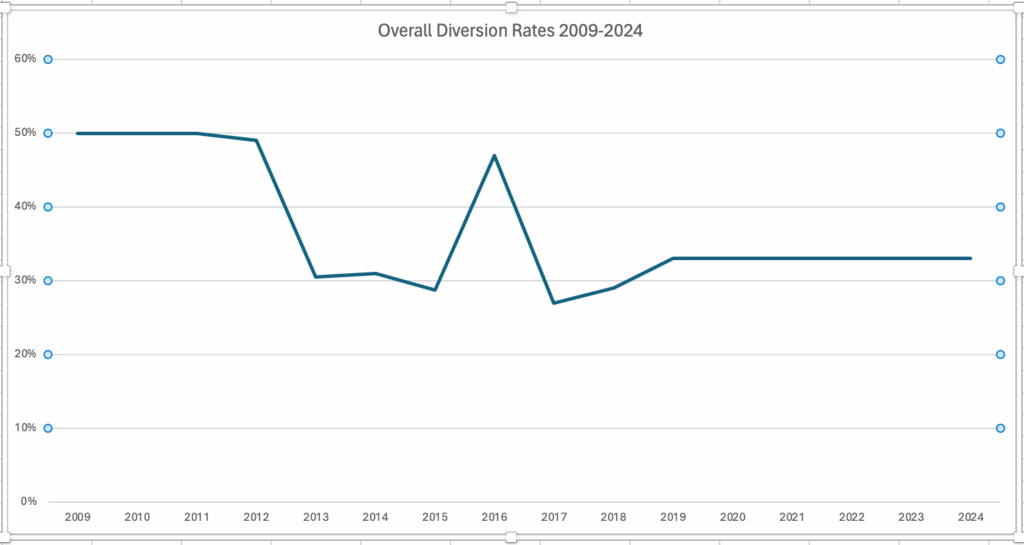
In 2009, half of materials collected by Recycle Ann Arbor from Ann Arbor residents were diverted from the landfill. Between 2019 and 2024, two-thirds of the materials collected within Ann Arbor by Recycle Ann Arbor went to the landfill.
by P.D. Lesko
Recycle Ann Arbor’s 2024 Recycling Report talks tons: “Our community diverted 22,234 tons of materials from ending up in a landfill.” The report omits any mention of the overall diversion rate, the percentage of materials collected that were diverted from the landfill. Despite tens of millions of tax dollars spent on multi-year contracts with Recycle Ann Arbor, despite the hype and promises in 2009 that single-stream recycling would save Ann Arbor money and increase the City’s solid waste diversion rate, public records show the City’s diversion rate has plummeted to 33 percent, from a high of 50 percent in 2009. The 33 percent diversion rate is up from a 29.3 percent diversion rate in 2018.
State of Michigan EGLE recycling research shows Michigan has steadily increased its recycling rate from 14.25 percent before 2019 to 23 percent in 2024 and to over 25 percent as of April 2025. EGLE forecasts that Michigan is on track to achieve the state’s goal of a 30 percent recycling rate by 2029. Ann Arbor has a 50 percent recycling rate (the percentage of residents who recycle) up from 38.5 percent in 2010.
Between 2010 and 2012, Berkeley, California, Walpole, Massachusetts, Auburn, Maine, and Concord, New Hampshire, among other U.S. cities voted not to adopt single-stream recycling, or abandoned single-stream recycling, according to a study by the Container Recycling Institute.
Ottawa and Toronto, Canada both decided against single-stream recycling, as well, after factoring in environmental and financial costs.
One town in England discontinued single-stream recycling and saw a 20 percent increase in landfill diversions in just two years.
Susan V. Collins is the President of the Container Recycling Institute. She explains who pushes single-stream recycling and why: “Single-stream was created by the waste management sector in an effort to reduce their high collection costs.”
Netanel Hutman works for the decades-old non-profit Institute for Local Self-Reliance. In his 2022 article titled “Single-Stream Recycling Doesn’t Work,” Hutman writes, “Waste monopolies were the first to push for single-stream recycling in the 2000s as growing recycling rates threatened their business model. Contracting waste management to spearhead recycling projects instead of resource management structures operations to waste rather than produce. As a result, waste management built single-stream recycling in garbage’s image. Single-stream facilitates the recycling-to-landfill pipeline.”
Now, thanks to over a decade of single-stream recycling, Ann Arbor is experiencing the results of an aspirational, “wishcycling” program. Wishcycling is putting something in the recycling bin and hoping it will be recycled, even if there is little evidence to confirm this assumption.
In 2009, then Ann Arbor recycling coordinator Tom McMurtrie projected that a $4.5 million investment in converting the Materials Recycling Facility to be able to process single-stream recycling would be recovered in seven years. McMurtrie’s math included a projected $30,000 annual savings in recycling Dumpster collection, $450,000 annual savings in curbside recycling and $450,000 annual revenues from merchant MRF users. McMurtrie told City Council Ann Arbor would see “higher recycling participation from a single-stream operation.” Recycling participation did increase, but diversion rates have plummeted.
In 2013, Tom McMurtrie told the Ann Arbor Observer he was “drafting a new ten-year plan. Once again, the goal will be to get homeowners’ diversion rate to 60 percent, and raise the overall recycling rate from 31 percent to 45 percent (businesses and homeowners).” Over a decade later, in Ann Arbor around 50 percent of residents recycle, but the City’s overall diversion rate has dropped by 35 percent since 2009.
Calculating The (Ecological) Cost of Single-Stream
Ann Arbor’s single-stream recycling program is expensive, not only insofar as tax dollars are concerned. Public records show the City’s recycling program, turned into a public-private partnership by contracting with WeCare Organics and Recycle Ann Arbor, is an ecological failure when measured by the percentage of recyclables diverted from the landfills. Collecting more tons of materials may look good on an annual recycling report, but the goal of recycling and composting is to divert materials from landfills. Increasing tons of materials collected is money in the coffers of Recycle Ann Arbor, but doesn’t reduce greenhouse gases.
A recent study published in the Journal of Industrial Ecology revealed that “recycling only reduces greenhouse gas emissions by 2-3 percent, whereas reducing consumption (reduce/reuse) can reduce emissions by up to 20 percent.” Research suggests that municipal programs that focus on the collection or recyclables and recycling are ecologically regressive. A2Zero’s buzz-wordy “Circular Economy” talks up reduce and reuse. City staffer Claire DeBlanc is the Sustainability Coordinator whose work “focuses on advancing initiatives and programs centered around building an equitable, sustainable, and resilient circular economy in Ann Arbor.”
Reduce. Reuse. Recycle. The “Circular Economy”
In 2023 Dr. Missy Stults, the City’s Sustainability and Innovations Director, offered up a 31-page report titled: “A²ZERO Circular Economy Community Engagement Strategy.” The “Resident Advisors” who helped produce the report were, according to the Report, drawn from “those who have been historically politically marginalized; Residents who live in neighborhoods identified in the Neighborhoods at Risk tool; Those who may experience the most climate vulnerability.”
In Feb. 2025, EGLE announced it had awarded $5.6 million in grants to build Michigan’s circular supply chains. The City of Ann Arbor applied for and was awarded $99,630 “to engage with frontline communities, businesses, and institutions (those affected most by environmental hazards), using the insights to create a Circular Economy Action Plan.”
While the City’s Office of Sustainability and Innovation (OSI) envisions a circular economy that engages the politically marginalized, the homeless, poor people and people of color, Ann Arbor’s single-stream recycling program has adversely impacted the local environment in terms of tons of collected materials that have ended up in the landfill and which produce CO2 and, worse still, methane.
According to the EPA, food waste in landfills contributes significantly to methane emissions, with an estimated 58 percent of landfill methane coming from decaying food scraps. Methane is a much more potent greenhouse gas than carbon dioxide, trapping heat in the atmosphere more effectively. According to EGLE, food is the most disposed of material in Michigan, with up to 1.5 million tons of food waste reaching Michigan landfills yearly. The U.S. Department of Agriculture estimates 30 percent to 40 percent of all food is landfilled.
Between 2011 and 2019, the City of Ann Arbor spent $20 million on its recycling contracts with Recycle Ann Arbor. The City also spent another almost $12 million for single-stream recycling including retro-fitting and then repairing the Materials Recovery Facility. In 2021, the City of Ann Arbor spent an estimated $10 million for recycling services, including a 5-year General Service Agreement with Recycle Ann Arbor and a two-year extension option. This amount was later increased to $10,586,637 to address increased costs for collection vehicles, according to city council records. In 2022, Ann Arbor spent a total of $853,211 on a new recycling education campaign, contracted with the Ecology Center. The City also spent $2 million annually on processing recyclables.
Public records show that in 2018, Recycle Ann Arbor diverted 14,000 tons of materials from the landfill. In 2009, the Ann Arbor Observer reported that “In 2009, Ann Arbor recycled 15,316 tons of materials, a 1,000-ton increase from the previous year.”
Former Ward 4 Council member Margie Teall summed up the City’s recycling program in 2014 to Concentrate: “I don’t think we’re near the forefront anymore. I think we started out that way, certainly. I think Recycle Ann Arbor was historically just on the cutting edge of that effort decades ago.”
Teall presently sits on the Board of the Ecology Center. Recycle Ann Arbor is a wholly-owned nonprofit subsidiary of The Ecology Center.
Cities across the country with zero waste goals are ditching single-stream recycling in part because in 2018 China stopped buying bales of recycled materials from the U.S. due to the high rates (25 percent and higher) of contamination of those bales. Ann Arbor doesn’t have a zero waste goal; A2Zero has publicized the non-specific goals of “reducing” waste and increasing recycling.
In 2020 Ann Arbor adopted its A2Zero $1 billion climate action plan. The city aims to reach carbon neutrality by 2030 via renewables and also declared a climate emergency in November 2019. In five years, the A2Zero Fifth Annual Report states that the 2.3 metric tons of CO2 generated within Ann Arbor in 2020 had been reduced to 1.97 metric tons in 2024, a 9.5 percent decrease. The Fifth Annual Report includes two mentions of recycling. The first mention is about a partnership whereby municipal wood waste is recycled. The second mention is that the Office of Sustainability and Innovation used tax dollars and “Funded Public Works’ to hire a new worker to support the expansion of commercial recycling.”
Natanel Hutman in his 2022 article writes, “The only effective recycling program is dual-stream. Single-stream’s simplicity is idyllic, reaping support from the hopeful who don’t understand the challenges our current recovery facilities face. Single-stream recycling beautifully illustrates the aspiration of zero waste.”
Robert Keller, the City of Ann Arbor’s Communications Specialist, commented in an email in response to questions about the drop in the overall diversion rate despite the increase in total tons of materials diverted from the landfill. Keller said, “To give a clearer picture, the 50% diversion rate from 2009 applied only to single-family residential collections. Our current ~33% diversion rate includes single-family, multi-family, and commercial streams. We’ve since moved away from tracking diversion by sector, and the inclusion of larger volume generators—who historically have lower diversion rates—has impacted the overall numbers.” Keller added, “More broadly, it’s important to note that recycling itself is no longer the primary goal. Over the last 15 years, our programs have evolved significantly in response to climate goals. The focus has shifted toward reducing consumption overall—’reduce’ and ‘reuse’ before ‘recycle.’ Relying on recycling alone, especially for the high volume of single-use plastics in circulation, can actually increase carbon emissions. Ideally, we reduce the need for recycling by rethinking and minimizing the materials used in the first place.”
Comments are closed, but trackbacks and pingbacks are open.