
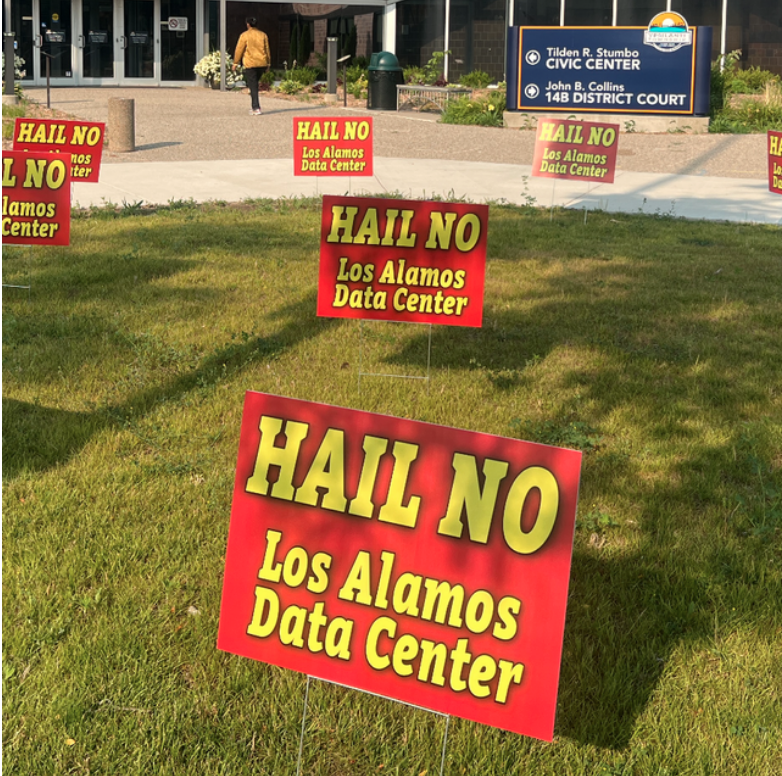
Ypsilanti Twp. Officials: “We Will Use Every Legal Means” to Stop Los Alamos-UM Data Center
by Brian Allnutt
Public officials are pledging to continue fighting the University of Michigan and Los Alamos National Laboratory’s planned Ypsilanti Township computing center after a vote green-lighting the facility’s construction.
The university refers to the $1.25 billion project as a “high performance computing center,” and opponents say it’s a data center. The project is planned for 144 acres adjacent to the Huron River on Textile Road in Ypsilanti Township. The university says it will use the facility for medical, energy, and computing research.
The university’s Board of Regents voted Thursday to proceed with work on the project, approving construction costs of up to $785 million.
Ypsilanti Township Attorney Doug Winters said the township will use every legal means necessary to stop the data center, including challenging the University of Michigan’s constitutional autonomy under state law.
Michigan’s Constitution gives university boards general supervision of their institutions and control and direction of all expenditures from the institutions’ funds.
The university did not respond to a question about a possible legal challenge.
“U of M has gone far afield when it comes to the constitutional autonomy which they have enjoyed by virtue of being a university,” Winters said at a Thursday panel discussion at Eastern Michigan University, noting that most of the project’s capacity is for Los Alamos.
The project does not serve an educational purpose for the university, he said.
A university informational page on the project says Los Alamos will bring specialized computing technology and expertise that benefits the university’s educational mission and research.
Los Alamos will use the facility for nuclear weapons research, The Michigan Daily reported in January, citing a Los Alamos deputy lab director.
The lab developed the world’s first atomic weapons.
Panelists say project will add to region’s environmental justice issues
The University of Michigan will commit $5 million to community projects in the Ypsilanti area over the next five years, outgoing President Domenico Grasso said in a Thursday statement.
The promise left speakers at the EMU discussion unmoved.
“We don’t want your community benefits,” Winters told a crowd of hundreds, which responded with loud applause. A price cannot be put on environmental justice, clean air, and democracy, he said.
As a state university, Michigan does not require local zoning approval for the project to move forward.
Community leaders previously said the university’s project will create costs for the neighboring community of Ypsilanti Township, which has more low-income areas and communities of color than Ann Arbor, without providing substantial benefits.
Panelists said the project would compound environmental justice issues in Southeast Michigan, furthering nuclear weapons technologies, and potentially disturbing Native American cultural sites.
Michigan says the project won’t impact the Huron River, which borders the property, and will create 30 to 50 technical support jobs; 200 higher-level research jobs; and 300 temporary construction jobs.
United Tribes of Michigan backs Ypsilanti Township
State Rep. Jimmie Wilson Jr., a Ypsilanti Democrat, said he’s optimistic Governor-elect Jocelyn Benson will follow through with a campaign promise to sign a moratorium on data center developments, he said Thursday.
Lawmakers are motivated to send this legislation to her desk in January, Wilson said.
Wilson, who won reelection Nov. 3, would support legislation backed by retiring state Rep. Reggie Miller, a Van Buren Township Democrat, including a bill to bar public officials from signing nondisclosure agreements when discussing data centers.
The United Tribes of Michigan, a collaborative alliance of Michigan’s 12 federally recognized tribes, has weighed in on the issue. UTM passed a resolution that backs a consultation by the university with state tribes, and supports Ypsilanti Township’s efforts to modify the development.
Ypsilanti Township is in an area that tribes used for river and trail travel, and includes burial sites and locations indicating Indigenous use, the resolution says.
The Detroit Free Press reported that Scott Slagor, cultural resource protection manager at the State Historic Preservation Office, notified university project manager Rob Green that a site boundary with a recorded cemetery overlaps with the property.
Green said on a Thursday press call that early property and historical record reviews have not identified any specific cultural site on the property. He acknowledged the work is not a substitute for ongoing professional review or tribal consultation.
Jamie Stuck, Michigan tribal legislative liaison, told the crowd at EMU that tribes have a legal status that mandates such consultations.
Role of Los Alamos draws scrutiny
Jay Coghlan, executive director of the organization Nuclear Watch New Mexico, said Thursday that the project is a bad deal for the state and the university, adding that it will benefit Los Alamos far more than the university.
Los Alamos did not respond to a request for comment on this story.
Patricia Hurn, an interim Michigan vice president for research and innovation, said on the university’s press call that its project is starting with a 50 MW capacity. Los Alamos is expected to use around 90% of the project’s power.
According to the 2024 grant request, Los Alamos is slated to provide $300 million in funding for the project, while $850 million will be provided by the university and strategic value partner debt financing.
The project received a $100 million grant in 2024 from the Michigan Strategic Fund and the Michigan Economic Development Corp., a taxpayer-funded agency providing business incentives.
The project’s overall cost is $1.25 billion.
In a Sept. 16 letter, U.S. Rep. Debbie Dingell (D-Ann Arbor) asked the university’s Grasso whether Los Alamos’ $300 million commitment of funds is contingent on site selection and regulatory and environmental approvals. Grasso replied Oct. 8 that “LANL has made no commitment of funds.”
Steve Ceccio, the computing center project lead and a Michigan professor of mechanical engineering, said the first phase of the project will bring tenants to the facility, and Los Alamos is the principal tenant.
“So upfront, Los Alamos or the tenants aren’t investing capital into the project, but they would help us defray the cost,” he told reporters Thursday.
The rent will recover both the operational costs for the facility and the capital cost of its construction, Ceccio said.
As part of the overall memorandum of understanding, the tenant would bring some of its own computational resources that would contribute to the overall total for the project, he said.
This article first appeared on Planet Detroit and is republished here with permission.


Comments are closed, but trackbacks and pingbacks are open.