
by Martha Stuit
You likely have heard of Alexander Hamilton, but do you know his sister-in-law, Angelica Schuyler Church?
Angelica led a wide-ranging social life, born in the United States in 1756 and spending time as an adult in England and France before returning to the U.S. In fact, a town in New York bears her name.
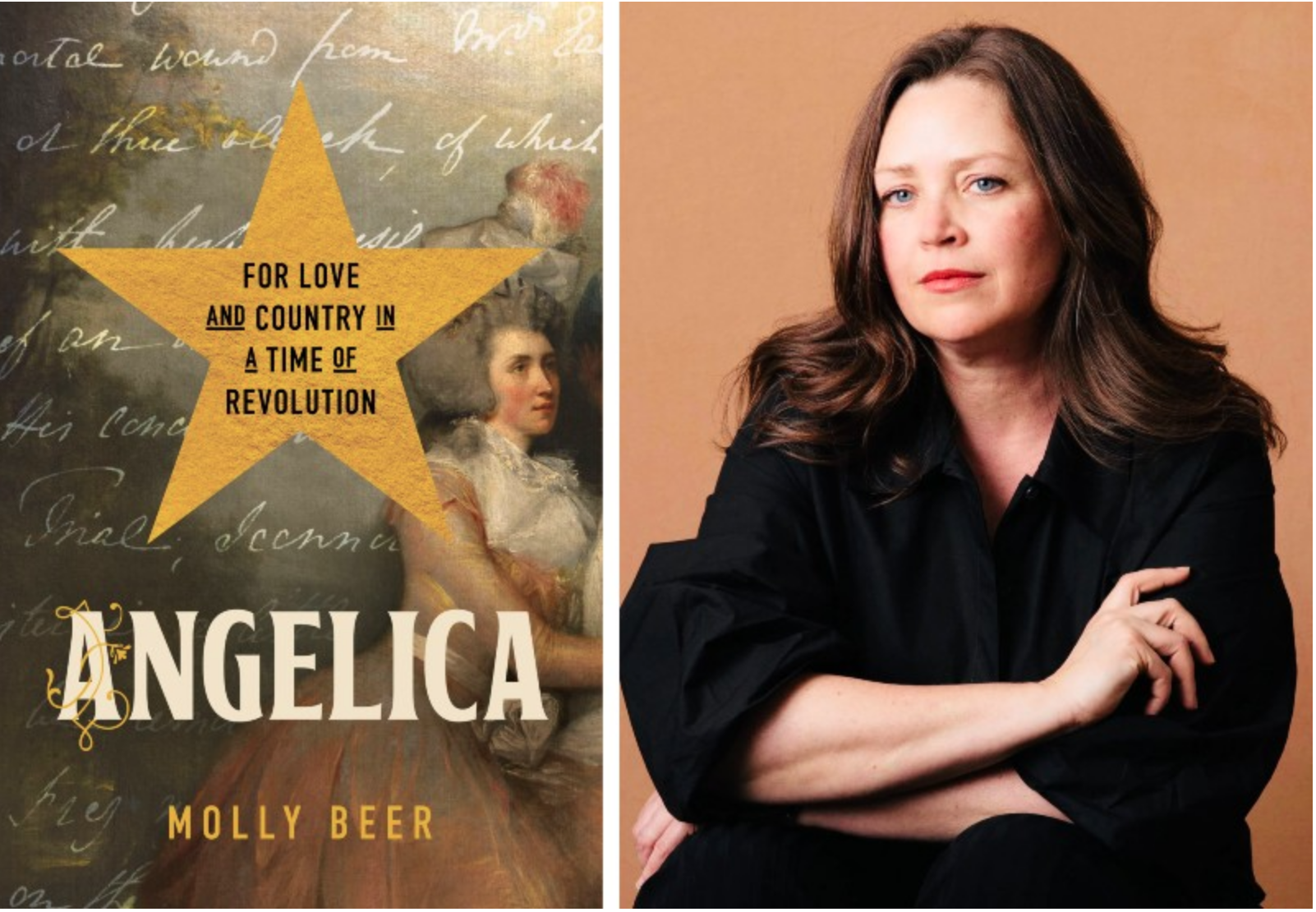
U-M lecturer Molly Beer wrote her new, eponymous biography, Angelica: For Love and Country in a Time of Revolution, as an account of Angelica’s “web of soft-power connections that spanned the War for Independence, the post-war years of tenuous peace, and the turbulent politics and rival ideologies that threatened to tear apart the nascent United States,” according to the book jacket.
That web contained many recognizable—and male, owing to the times—names. First, there was Angelica’s father, Philip Schuyler, who was a Revolutionary War general. Alexander Hamilton married her sister, Elizabeth. The General and first U.S. President George Washington, the third U.S. President Thomas Jefferson, and Dr. Benjamin Franklin, among others, were in her orbit, too.
Yet, Angelica also counted many influential female friends who were involved in the revolutionary process, in addition to her sisters. The book contains stories about these active women: Lucy Knox, Catherine Greene, Janet Montgomery, Mary Byrd, Sarah Jay (and Abbe), Martha Washington, Abigail Adams, and even royalists—Lady Mary Johnson, the Haudenosaunee diplomat Molly Brant, and Baroness Riedesel. Her contacts in Europe included Maria Cosway and Marguerite de Corny, among others.
In reflecting on Angelica’s relationships and approaches, Beer writes:
Social architecture, the layer of human interactions, was close to the heart of a woman who understood that every social gathering was a microcosmic experiment wherein the individual participated in friendship, alliance, kinship, patriotism, community, and the society that was as much the making of a country as the acquisition of land or the making of laws.
Angelica found ways to exert influence through such means.
During the formative years of the U.S., Angelica navigated the political aspirations of her family members, the business dealings of her husband, John Barker Church, and her own undertaking of motherhood. At the same time, Angelica faced the limited rights of women and operated in a time when slavery was perniciously pervasive in the U.S. The biography Angelica characterizes what these times were like for not only Angelica but also her loved ones and close friends, in part through their frequent and dynamic correspondence via letters.
Later in Angelica’s life, her oldest son, Philip Church, tries to discourage her from traveling. Beer takes the opportunity to illustrate how Angelica was built of stronger stuff:
Angelica’s son had forgotten the distances to which she’d gone before, over land and sea, for the sake of the people she loved, undeterred by blackflies or mosquitoes, the fatigue of riding in a saddle, or by war, fear of shipwreck, or the complications of traveling with a newborn. “When my friends require my assistance there are few more willing than myself,” she had boasted to Thomas Jefferson when she was younger.
Indeed, Angelica strategically moved around the U.S. during the Revolutionary War, provided unofficial diplomatic relations while living in Europe, supported her extended family’s endeavors, and built homes in multiple places, right up until she passed away in 1814 in New York.
Beer will give a talk about Angelica on Thursday, November 13, at 6 pm at AADL’s Downtown location.
Beer and I spoke about her new book, Beer’s connection to Angelica, New York, her research on this woman’s life, her teaching, and her involvement with the 250th anniversary of the U.S.
Q: Your hometown is Angelica, New York, which is named for Angelica Schuyler Church. Did you travel there for your book research? What is this area like, and how does it relate to your book?
A: I absolutely went back to Angelica. I wrote my earliest drafts at the back of the Crooked Door Antique Store on Main Street, with Amish carts trotting past and the occasional manure-slurry semi rattling the whole building and the local radio station broadcasting out of the display window.
The town only shows up in the final chapter of the book, but it’s the reason that I wrote this book, and it’s also the culmination of Angelica Schuyler Church’s life work and travels.
Angelica was originally from rural New York. She grew up in Albany, which was so remote that it was still a Dutch-speaking community, even though the former colony of New Netherland had been British New York for a century. But the times were turbulent, and she was compelled, partly by her personality and partly by the conditions of history, to leave home for a far-flung life that ranged from Revolutionary War army encampments to the salons of Paris and high society in London. But she always loved rural places. Thomas Jefferson, who had his own agrarian romanticism, teased Angelica for being “country mad.” Eventually, history swept her home again, and when the U.S. started to look westward, she joined that movement too. The year of Lewis and Clark’s Expedition of Discovery, Angelica traveled 450 miles—the final 50 of which were all but impassable by wagon—to help draft a model American town.
So I grew up in the town that Angelica imagined into being, a town with streets radiating from the large public Park Circle like a Parisian arrondissement. The land my family farmed first belonged to the Baron and Baroness Hyde de Neuville, a diplomat and an artist, respectively. But by my lifetime, Angelica’s philosophical pastoral and the Jeffersonian agrarian ideal wasn’t looking so rosy. Western New York, near the Pennsylvania border, is culturally northernmost Appalachia. Everyone I knew worked to the bone, but during the 1980s agriculture crisis, the county was the highest per capita welfare recipient in the state. By 2016, when I began writing this book, Angelica-the-town was the archetypal “rural America” that newspapers treated like another country.
In other words, the questions that drove me to write about Angelica Schuyler Church start with the town and go back to the beginning: of Angelica, of New York, and of the United States.
Q: How did you get started with researching Angelica Schuyler Church and turning her story into your book?
A: I have been experimenting with writing Angelica Schuyler Church’s story for as long as I’ve been writing nonfiction. She was a childhood fascination of mine, growing up in Angelica, New York. And I’m a place-writer, so any time I tried to describe where I was from, Angelica-the-woman was tangled up in my answer.
Then, in the summer of 2016, I was offered free childcare and a desk at the back of a defunct antique shop if I would come home to Angelica, New York, and write up a sketch of Angelica Schuyler Church. Hamilton: An American Musical had become a hit, and the town wanted to be ready in case any tourists showed up. I thought it would just be a summer project. I’d just fact-check the oral history I knew, visit her houses, read her photocopied letters at the local library, and write up a biographical sketch readers could contrast with her fictionalized character in the Broadway play.
But when I started to research her life in earnest, it was like Angelica’s story had been pent up for two and a half centuries. It just exploded open. People had been preserving her history for generations—she wasn’t lost; no one was looking for her. Letters, deeds, books, shards of porcelain picked from the mansion’s old middens, braids of hair in file folders, newspaper articles, shopping lists, recipes, portraits, more letters—it was stunning, overwhelming even.
So I kept going.
Q: It sounds as though your paths were meant to cross. Let’s talk about your research. Quotes from letters are liberally sprinkled throughout Angelica. What about Angelica’s life did you glean from the letters?
A: One of the pleasures of reading letters from the past is that we get to see history from its midst. It’s like dramatic irony in fiction. As readers in 2025, we know who won the Revolutionary War, but 20-year-old Angelica, writing to her father, General Schuyler, on July 4, 1776, did not. But Angelica knew what we don’t—what the lived experience of that war, day by difficult day, was like.
Writing this book, I really tried to show more than I tell and to stay out of the way of the story. I wanted to show her life and times as she lived them—sequentially, without knowing what was coming or how the war would end or who would become a U.S. president. The letters are Angelica speaking in her own words and spellings and punctuation at particular times, knowing only what she knew at that moment. Of course, for research, I was using her handwritten letters, which add another layer of texture. Her handwriting varies—tight and formal or big and relaxed, and that sometimes gave me a sense of her mood or attitude.
Most of all, what I experience reading the letters is time. The Battle of Yorktown, which we remember as ending the war, took place in 1781, but the news that Britain would sue for peace did not arrive until 1783. George Washington was not inaugurated president until 1789. Angelica went to Yorktown after that battle, and she went to Paris to toast the signing of the Treaty of Paris that ended the American War for Independence, and she crossed the Atlantic once again to dance at George Washington’s inaugural balls. So her letters offer this time-lapse view of this whole era that is so critical to this country’s history.
Q: Since men held office and women could not vote during this era and beyond, which were just a few of the issues that affected the historical record, I am curious how you formed a clear view of Angelica’s life to tell in this book. Are there gaps in Angelica’s story that you wish you knew more about?
A: In the beginning, researching Angelica’s life felt like doing a one-million-piece puzzle without a picture on the box. If I had been writing about one of her famous male friends, I would have had the basic shape—an AADL catalog search for Thomas Jefferson produces 142 books, for example. There are no biographies of Angelica before this one. And there aren’t many biographies that focus on any women from Angelica’s time, although two I particularly admire are Woody Holton’s Abigail Adams and Annette Gordon-Reed’s The Hemingses of Monticello. So, I had to feel my way forward blindly until enough pieces began to click together that I could see the shape of things. Of course, yes, there are always gaps. I hope there will be more books about her in the future that flesh her out more fully and in new ways—that’s how history grows—but I think readers will get a sense of her as a real person in this book.
Q: Angelica’s choices caused friction with her family, particularly her decision to elope, a practice that others in her family also took up. This act, among others, struck me as modern for the late 1800s. Were there any aspects of her life that you found relatable today?
A: The early days of the U.S. took place so long ago that the people who lived then are as culturally distinct from us now as if they lived in another country. But some of that distance is also a matter of perspective. One reason women in history can seem totally unrelatable is because, in books that center men, they’re flat characters or foils: the good mother, the temptress, the scold, the innocent girl, etc. I think that centering a story on a woman means showing her with more dimension and complexity, and then, of course, she’s more relatable. In the Schuyler children’s predilection for eloping, I see their mother’s power, influence, and agenda. And the conflict this creates between mother and daughter reveals Angelica’s manipulative side. In their actions and words, in their wanting mutually exclusive things, I see women I absolutely recognize.
I also related to their circumstances. Angelica’s lifetime spanned a period of drastic change in women’s roles in the social and political order, elements of which we still grapple with today—i.e., in 250 years of U.S. history, there has never been a female president. In her girlhood, Catherine the Great of Russia and Maria Theresa of Austria were prominent female heads of state. Then, like all wars, the Revolutionary War called upon women to run farms and businesses while fathers, husbands, sons, and many women with them went off to war. In the war’s aftermath, with everyone talking about natural—“inalienable”—rights, independence, freedom of speech, and so forth, women expected to gain still more liberty.
The 1780s and ’90s produced dozens of books in the U.S., France, and England that called for women’s rights, the education of girls, even suffrage. Women stopped wearing corsets in favor of “natural” form-revealing Grecian-style gowns. Breastfeeding was in. Even Queen Marie-Antoinette, who was the same as Angelica, posed for her portrait in a cotton dress and straw hat—although that proved to be a step too far.
Then that wave of proto-feminism ended, and the backlash came. As it does.
Q: Many other people, both well-known and not, fill the pages, and their associations with Angelica inform the book, too. Was Angelica’s broad network unusual for the time?
A: In Angelica’s time, connections were often more valuable than monetary wealth. The reason the Schuylers won’t let Angelica marry the man she eloped with was because he had no known connections. Everyone cultivated their friendships with care, and letters of introduction were commonly used, even when visiting someone they already knew. For example, Alexander Hamilton wrote Angelica Church a letter of introduction for John Jay to carry when he traveled to England to negotiate what came to be called the Jay Treaty—even though Angelica and John Jay were cousins and had known each other in New York political circles long before either had met Alexander Hamilton. So rather an actual introduction, the letter was intended to double John Jay’s claim on Angelica’s help with his mission.
Angelica’s network was expansive, but, more importantly, she used it. Gouverneur Morris, who replaced Thomas Jefferson as U.S. ambassador to France, described a ball at Angelica’s London house that was attended by the Prince of Wales and the Duke of Orleans and a slew of other liberal leaders representing three countries—that’s a pretty significant political gathering. And when the French Revolution devolved into a bloodbath, she used her network to help French veterans of the American Revolution escape the guillotine.
Q: Turning our attention to today and your position as a lecturer, tell us about your teaching at the University of Michigan. I saw a course called “Introduction to Literary Journalism” on your page. What does this topic involve? How do you use these principles in your own writing?
A: The Intro to Literary Journalism course that I taught is very connected to this project! That course is the first in a three-part documentary writing sequence called the Great Lakes Writers Corps (GLWC), offered by the U-M English Department to sophomores and juniors. It’s an intense and amazing program that trains students to design, research, and write in-depth nonfiction about Great Lakes issues and communities. Like I said, I think of Angelica as a place book, and since my hometown of Angelica is upstream of Lake Ontario and downwind/snow of Lake Erie, it is even in the region. And yes, writing this book while leading GLWC felt very symbiotic—and I definitely made my students learned how to access and use archives. Unfortunately, U-M won’t allow a lecturer to reduce their course-load during a three-year contract, so when I got the book contract with W. W. Norton, and with it a deadline, I had to choose one or the other. But GLWC has great new leadership, and I have finished the book—so happy ending. This coming semester, I’ll be teaching general nonfiction, which I love, and multigenre creative writing.
Q: What have you been reading this summer?
A: Two great new nonfiction books I’ve read this summer are Taking Manhattan, Russell Shorto’s new history of when New Netherland became the colony of New York, and Alive Day, a searing new memoir by Karie Fugett about the war in Iraq. I vehemently recommend both!
Q: What are you researching and/or writing next?
A: My 2026 schedule is filling up with U.S. 250th commemorative events, so it will mostly be a speaking year and a listening year. But I’m excited to get involved in the national conversation about how the American Revolution started, and where it’s headed next.
First published in Pulp.
Comments are closed, but trackbacks and pingbacks are open.