
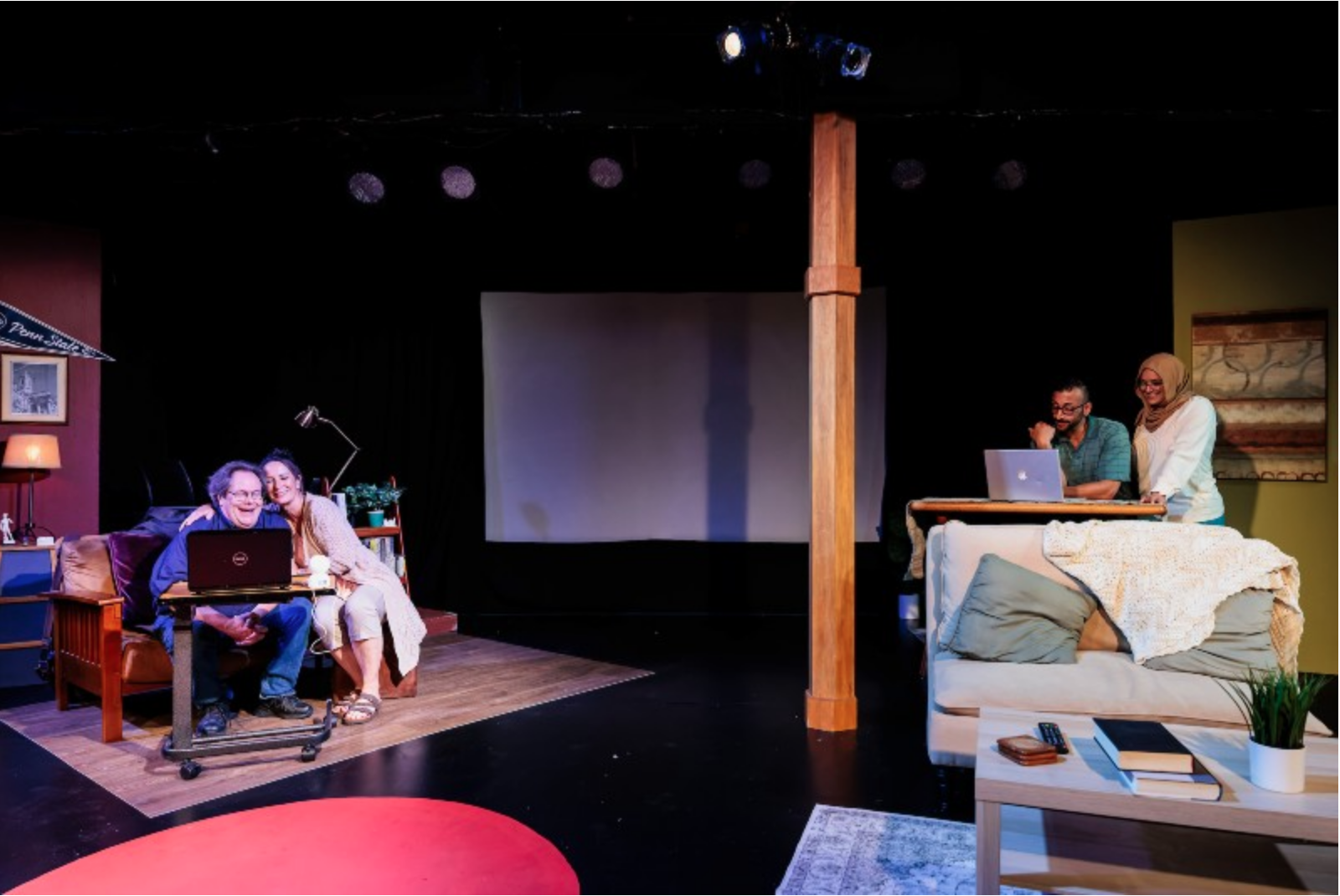
Playwright David Wells’ Radical Empathy is a challenging look at that movement through the relationship of an American couple and an Iraqi couple during the conflict between U.S. forces and ISIS from 2011 to 2018.
by Hugh Gallagher
There is a movement in the United States to reach out to people in other countries through person-to-person contact. The intention is to develop empathy for other people, other cultures, and other points of view. The idea is admirable, but “empathy” is not always the same for everyone.
Playwright David Wells’ Radical Empathy is a challenging look at that movement through the relationship of an American couple and an Iraqi couple during the conflict between U.S. forces and ISIS from 2011 to 2018. Wells has found a perfect theater for his thought-provoking play at Ann Arbor’s Theatre Nova, a small theater with big ambitions.
A TED Talk lecturer gives an emotional, riveting, and eventually viral lecture on radical empathy. He challenges his audience to imagine how Americans would feel if, in the past, China had taken control of American coal, China had prospered, and Americans had fallen into poverty except for the richest citizens. He then brought the argument to the present—2011—and the United States is prosperous, but the Iraqi people are caught in a seemingly endless series of conflicts with the United States while also dealing with internal forces.
The lecture draws the attention of an Iraqi man. He is middle-class, unhappy with life under the control of ISIS, and wants to learn more about Radical Empathy. He writes to the lecturer, and a person-to-person conversation begins that also includes the wives of the two men.
Phil Powers plays Sam, the gruff, idealistic, excitable academic. He fully embraces the radical empathy movement and is elated to practice empathy person-to-person as intended. Powers brings a giddy sense of humor but also reaches deep during some highly emotional moments. The character Sam is, on the one hand, a true believer in what he’s presenting, and on the other hand, he is also excited by the opportunities the movement allows for his career.
Jeannine Coughlin plays Laurie, Sam’s loving and intelligent wife who takes charge of Sam’s newfound celebrity for the lecture circuit. Coughlin does that balance between the ambitious and capable agent and the loving wife.
Fedor Kinaya plays Basim, the Iraqi man who makes the connection with Sam. Basim is a proud Iraqi, but also a prisoner of sorts to ISIS. He is interested in Sam’s ideas, and Sam offers him a chance to join him through long-distance learning as part of his lectures. Kinaya plays Basim as a quiet man who is cautious but curious. Even when war and death come, Kinaya shows his pain in a totally different way than Sam.
Maya Gangadharan plays Mayada, Basim’s bright but wary wife. She offers her advice about caution when dealing with Americans, but she leaves the decision to Basim. Gangadharan’s Mayada is like Kinaya’s Basim, reserved, cautious. Gangadharan also brings out the warmth of Mayada and the good counsel that becomes of special importance later in the play.
Director Briana O’Neal understands that radical empathy can mean very different things in different cultures and under different governments. This is especially the case in a situation where one couple, no matter how prosperous, is in a devastating war, and the other couple is aware of the war but remote from it. O’Neal brings out these differences not just in words but in the smallest of gestures.
A few years pass, and the friendship grows, but the Iraqi couple is not allowed to travel. Though Basim makes every effort to gain support.
The war eventually comes to Basim and Mayada. What happens challenges the idea of radical empathy or at least gives focus on what Americans mean by that idea. Sam and Basim realize they disagree on a serious matter, and that drives a wedge between them.
Wells’ play was inspired by real events, and he balances wry humor and devastating drama. Radical Empathy is an interesting look at how our best intentions can go awry. But Wells also makes it clear that the person-to-person interaction is, in the long run, a step toward understanding and away from war.
The world continues to have war, and people are still separated across ethnic, racial, political, and corporate divides. In the Middle East and Ukraine, the world holds its breath. We need some radical empathy.
First published in PULP.
Theatre Nova presents David Wells’ “Radical Empathy” at 410 W. Huron Street, Ann Arbor, at 8 pm Fridays and Saturdays, 3 pm Saturdays, and 2 pm Sundays through August 24. For tickets, call 734-635-8450 or visit Theatre Nova’s website.
Comments are closed, but trackbacks and pingbacks are open.